
Building a Jetter Truck: Equipment List and Setup Guide
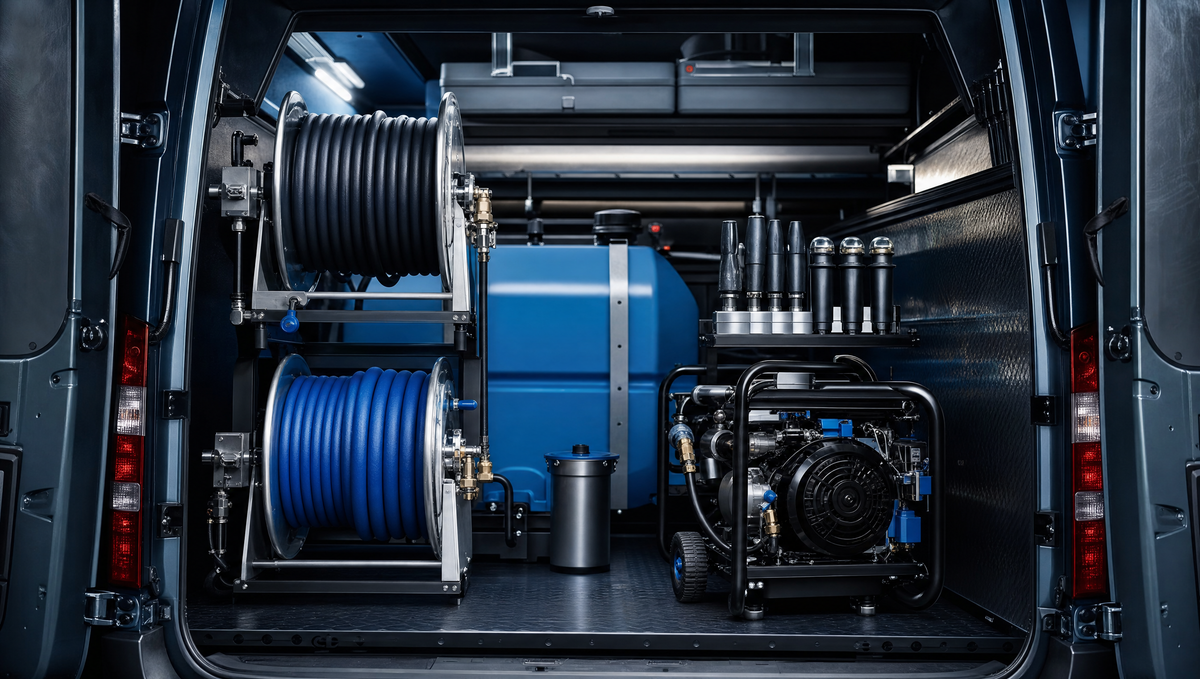
A well-built jetter truck is a mobile drain cleaning business. Everything you need for any job, organized and accessible, rolling to the next call. Here is how to build one that works for daily production, not just looks good in photos.
Choosing Your Vehicle
Van vs Truck vs Trailer
Cargo van (Transit, Sprinter, ProMaster): Weather-protected equipment, professional appearance, and everything is self-contained. Best for residential and light commercial operations. Downsides: limited space for large equipment, harder to service the jetter inside the van.
Pickup truck with service body: More accessible equipment storage, easy to service, and you can swap the jetter between vehicles if needed. A flatbed or utility body works well. Downside: equipment is exposed to weather unless covered.
Truck + trailer: Maximum capacity. You can build a dedicated jetter trailer and tow it with your existing truck. Best for larger operations or commercial work requiring bigger machines. Downside: harder to navigate residential neighborhoods and driveways.
Size Considerations
For a dedicated drain cleaning operation, a 3/4-ton truck or full-size cargo van is the minimum for carrying a jetter, water tank, hose reels, nozzle storage, camera equipment, and hand tools. Do not underestimate the weight—a 300-gallon water tank alone weighs 2,500 pounds when full.
The Core Equipment List
Jetter Unit
Your primary tool. For residential and light commercial, a unit producing 8-12 GPM at 3,500-4,000 PSI covers most situations. Mount it securely—a loose jetter under braking is a safety hazard and an equipment destroyer.
Water Tank
200-300 gallons is the sweet spot for residential work. Larger tanks mean fewer refills but more weight. Install a water level gauge visible from outside the tank so you never run dry mid-job. Include a fill port that connects to a standard garden hose for easy refilling at the customer site.
Hose Reels
Mount at least two hose reels:
- Primary jetter hose reel: 300-500 feet of jetter hose, power rewind if budget allows
- Garden hose reel: 100 feet for connecting to water supply
Position the jetter hose reel for easy deployment—ideally at the rear or side of the vehicle with clear access.
Nozzle Storage
Build or buy an organized nozzle storage system. Foam-lined drawers, wall-mounted racks, or purpose-built cases keep nozzles protected and accessible. You should be able to grab any nozzle within 30 seconds.
Stock your truck with a complete nozzle kit covering your common scenarios:
- Penetrating nozzle (1-2 sizes)
- Flushing nozzle (2-3 sizes for different pipe diameters)
- Grease nozzle
- Root-cutting nozzle
- Specialty nozzles for your common jobs
- Spare inserts for each nozzle type
Sewer Camera
Mount the camera system where it is protected but quickly deployable. Many plumbers dedicate a compartment or drawer to camera equipment. Include the push rod, monitor, and recording device. Battery charging should happen while driving between jobs.
Drain Snake
Keep a cable machine for retrieval work and quick jobs. A small sectional machine takes minimal space and handles situations where a jetter is overkill.
Support Equipment
- Toolbox: Wrenches for cleanout caps, pipe wrenches, pliers, flashlight, and basic hand tools
- Safety gear: Rubber gloves, eye protection, rubber boots, first aid kit
- Cleaning supplies: Disinfectant, rags, bucket, tarps to protect customer property
- Spare parts: Extra hose fittings, O-rings, nozzle inserts, and a spare section of jetter hose
- Paperwork/invoicing: Tablet or invoice book, business cards, brochures
- Cones and signage: Traffic cones for street-side cleanouts, "Work in Progress" signs
Truck Organization Principles
Workflow Layout
Organize equipment in the order you use it. Camera goes in first (for inspection), nozzles next (for selection), jetter hose last (for deployment). When you arrive at a job, you work front to back through your truck. When you finish, you reload back to front.
Weight Distribution
Water tank goes over or ahead of the rear axle, not behind it. Heavy equipment centered, lighter items around the perimeter. Poor weight distribution affects handling and braking—dangerous with 2,500+ pounds of water sloshing around.
Accessibility
You should be able to access every piece of equipment without moving three other things first. If you have to unstack equipment to reach your root cutter, your layout needs work. Wall-mounted and drawer-based storage keeps things accessible.
Professional Appearance
Your truck is your business card. A clean, organized, professionally wrapped truck communicates competence before you say a word. Customers are letting you access their property and work on their plumbing—they want to see that you take your work seriously. Every neighbor who sees your truck parked in a driveway is a potential customer.
Shop nozzles at jetterprosupply.com or call (866) 595-0515.
Put it into practice: Plumber Kits — Outfitting a jetter truck is easier from a kit that bundles the nozzles you'll actually use. Questions? Call (864) 804-6637.
Still pricing the machine itself? See what a jetter costs.
Running more than one truck? Read why every jetter truck in your fleet should carry the same four nozzles.
Need the right nozzle for the job?
Talk to someone who runs this gear, or shop our full lineup of pro-grade jetting nozzles.