
How to Jet a Kitchen Drain Line: Step-by-Step for Plumbers
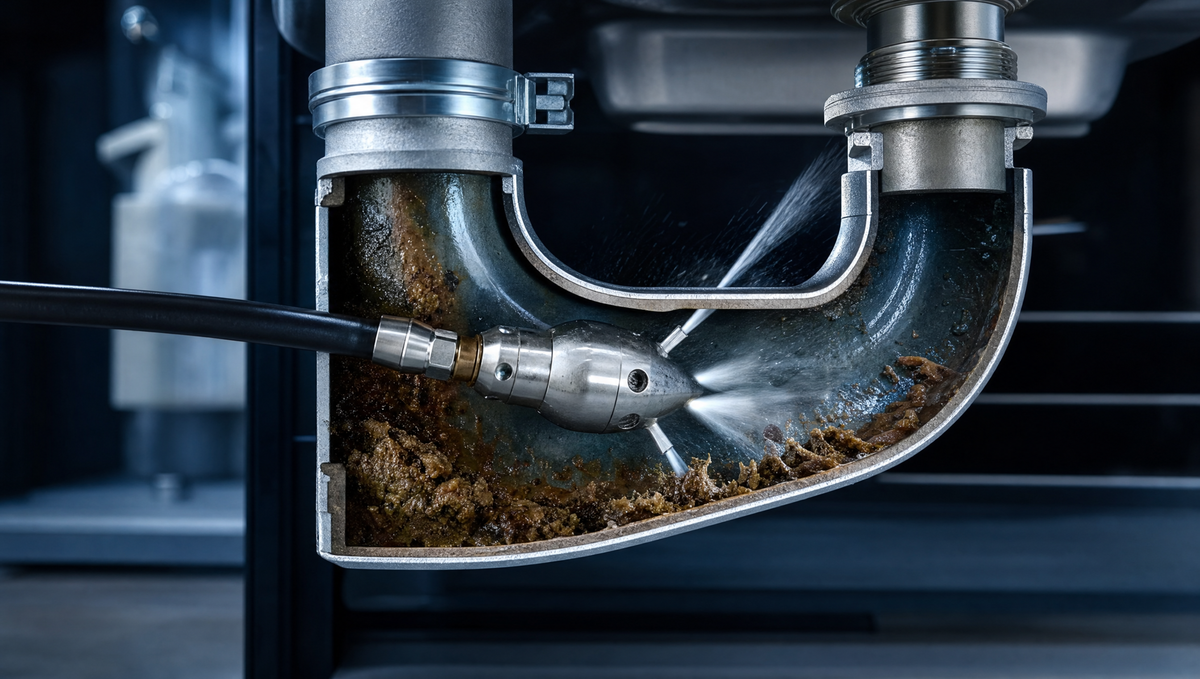
Kitchen drain lines are grease magnets. Every restaurant, every home kitchen—grease goes down the drain and coats the pipe walls until flow slows to a crawl. Jetting is the only method that truly cleans kitchen lines instead of just poking a hole through the buildup. Here is exactly how to do it right.
Why Kitchen Lines Are Different
Kitchen drain lines accumulate grease, soap residue, and food particles that solidify into a thick coating inside the pipe. Unlike a simple hair clog in a bathroom line, grease buildup is adhesive—it sticks to the pipe walls and hardens over time. A snake punches through it temporarily. A jetter strips it off completely.
Most kitchen lines are 1.5 to 2 inches from the sink trap, transitioning to 2 to 3 inches as they connect to the main drain. The smaller diameter means less room for error with nozzle sizing.
Equipment Setup
Nozzle Selection
For grease-packed kitchen lines, you want a nozzle with rear-facing jets at a wide angle—30 to 45 degrees off center. This sprays the pipe walls aggressively to cut through grease coating. The Egg Devastator style nozzles with multi-directional jets are purpose-built for this work, attacking buildup from every angle.
Use a nozzle sized appropriately for the pipe. In a 2-inch line, your nozzle should be no more than about 60% of the pipe diameter. Too large and it will not navigate bends.
Pressure Settings
Kitchen lines typically do not need maximum pressure. For 2-inch lines, 2,500-3,500 PSI at 4-6 GPM is effective. Too much pressure in a small line risks damaging connections or pushing grease into areas you do not want it.
If the line connects to a garbage disposal or dishwasher, be aware of branch connections. High pressure can force water back through these connections.
Step-by-Step Process
Step 1: Access the Line
Identify your access point. Under-sink cleanouts are ideal. If there is no cleanout, you may need to pull the P-trap or access from a downstream cleanout. Pulling the P-trap gives you direct access but makes a mess—have a bucket ready.
Step 2: Pre-Inspect If Possible
A small push camera down the kitchen line shows you exactly what you are dealing with. Is it solid grease buildup along the whole length? A specific blockage point? Roots entering at a joint? This tells you which nozzle to use and how aggressive to be.
Step 3: Insert the Hose with Water Running
Never insert a dry hose. Start your water flow and feed the hose into the line. The nozzle jets will pull the hose forward. Feed at a steady pace—do not force it. If you feel resistance at a bend, ease back slightly and let the water work the nozzle around the turn.
Step 4: Work in Sections
Do not just run the hose to the end and pull it back. Work in sections—advance 3 to 5 feet, pull back 2 feet, advance again. This repeated scrubbing action is what removes built-up grease from the walls.
Watch the water flowing back toward you at the access point. When it starts coming back murky with grease, you know the nozzle is working. When it clears up, that section is clean.
Step 5: Full-Length Pass
After working sections, run the hose the full length of the kitchen line to the main connection. Then slowly retrieve it with water flowing. The rear jets give the pipe walls a final cleaning on the way back out.
Step 6: Hot Water Flush
After jetting, run hot water through the line for 3 to 5 minutes. This helps flush any remaining emulsified grease downstream and through the main line. Inform the customer that running hot water after heavy cooking is the best preventive measure they can take.
Common Kitchen Line Challenges
- Tight bends: Kitchen lines often have sharp turns. Use a flexible hose and smaller nozzle to navigate them.
- Low-slope installations: Some kitchen lines have minimal slope, causing grease to settle and accumulate faster. These lines need more aggressive cleaning and benefit from maintenance schedules.
- Garbage disposal debris: Ground food particles mixed with grease create a cement-like buildup. Expect to spend more time on these lines.
Selling Kitchen Line Maintenance
Kitchen lines are your best opportunity for recurring revenue. After cleaning, explain to the customer that grease buildup is ongoing. Recommend quarterly or semi-annual jetting to prevent blockages. Restaurants should be on a monthly schedule.
This is not upselling—it is honest maintenance advice. A kitchen line that gets jetted twice a year never fully blocks, which means less emergency calls for you and zero disruption for the customer.
The Right Nozzle Matters
Using a general-purpose nozzle on a grease-packed kitchen line is like using a flathead screwdriver on a Phillips screw—it kind of works but not well. Purpose-built grease nozzles with the right jet angle and flow pattern cut your cleaning time significantly and deliver better results.
Shop nozzles at jetterprosupply.com or call (866) 595-0515.
Put it into practice: Grease & Drain Line Nozzles — Kitchen lines are grease work, and these nozzles are made for it. Questions? Call (864) 804-6637.
Need the right nozzle for the job?
Talk to someone who runs this gear, or shop our full lineup of pro-grade jetting nozzles.