
The Best Nozzle Configuration for Grease-Packed Lines
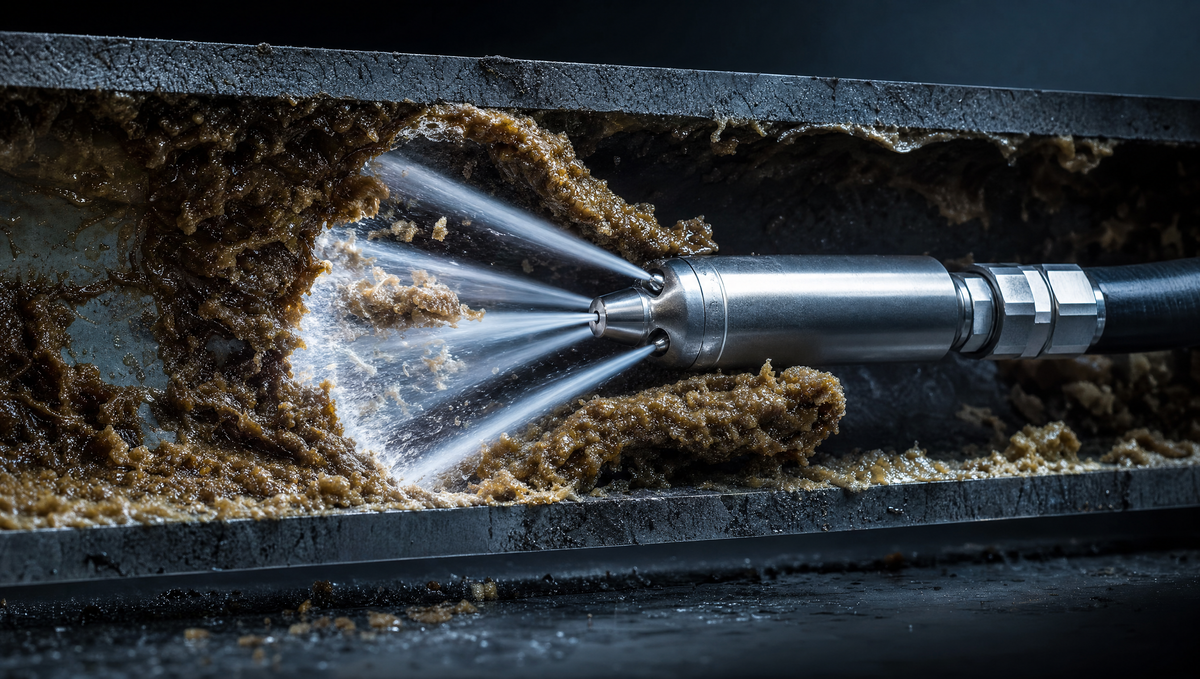
Grease is the most common enemy in drain cleaning, and it demands a specific approach. The wrong nozzle turns a 30-minute grease job into an hour-long battle. The right nozzle configuration strips grease efficiently and leaves the pipe clean. Here is what works.
Grease work is also the most profitable drain call most plumbers skip.
Why Grease Requires a Different Nozzle
Grease buildup coats pipe walls in layers. It is adhesive, it hardens over time, and a straight-ahead water jet just punches through it. To actually remove grease, you need jets that hit the pipe walls at the right angle with enough spread and force to shear the grease off the surface.
Standard flushing nozzles have rear jets angled at about 15 degrees. That is fine for loose debris and light buildup, but grease laughs at 15-degree jets. You need wider angles and more aggressive patterns.
Optimal Jet Configuration for Grease
Rear Jet Angle: 30-45 Degrees
The wider the angle, the more directly the jets hit the pipe walls. For grease removal, 30 to 45 degrees off the center axis is the sweet spot. This creates a cone of water that scrubs the pipe circumference as the nozzle travels through.
Number of Rear Jets: 6 to 8
More jets mean more coverage per pass. A nozzle with 4 rear jets leaves gaps between spray patterns, requiring multiple passes. Six to eight jets provide near-complete wall coverage in a single pass. The Egg Devastator nozzle uses a multi-directional jet layout that attacks grease from every angle—exactly what you want in a packed kitchen line.
Forward Jet: Small or None
For pure grease cleaning where the line is not fully blocked, a nozzle without a forward jet actually works better. All the water energy goes to the rear wall-cleaning jets. If you are dealing with a blocked grease line, start with a penetrating nozzle to break through, then switch to your grease nozzle for the cleaning pass.
Nozzle Body Shape Matters
Rounded or egg-shaped nozzle bodies navigate bends better than flat-front designs in grease-packed lines. The smooth profile slides through buildup and around turns without catching. This matters in kitchen lines that often have multiple bends between the sink and the main drain.
GPM and PSI for Grease Work
Grease removal is more about GPM than PSI. High volume at moderate pressure emulsifies grease effectively. Here is the balance:
- 2-inch lines: 3-4 GPM at 2,500-3,000 PSI
- 3-inch lines: 5-8 GPM at 3,000-3,500 PSI
- 4-inch lines: 8-12 GPM at 3,500-4,000 PSI
The volume of water is what carries emulsified grease downstream. Starve the nozzle of GPM and the grease re-deposits further down the pipe instead of flushing out.
Hot Water Advantage
If your jetter setup allows it, using warm or hot water dramatically improves grease removal. Hot water softens and liquefies grease on contact, making it easier to strip from pipe walls. Some plumbers carry a small inline heater or use their hot water tank supply for grease-heavy jobs.
Even running the customer hot water tap while you jet adds warm water to the equation and helps.
Technique: Working Grease Lines
- Penetrate first if blocked: Use a penetrating nozzle to establish flow.
- Switch to grease nozzle: Once water is flowing, switch to your wide-angle grease nozzle.
- Work in sections: Advance 3-5 feet, pull back 2, advance again. Repeat until you reach the end.
- Multiple passes: Heavy grease usually requires 2-3 passes. First pass breaks the bulk, subsequent passes clean the walls.
- Slow retrieval: Pull the hose back slowly with water running. The rear jets do their best work during retrieval.
- Hot water flush: Finish with 5 minutes of hot water to clear any remaining grease.
Restaurant vs Residential Grease
Restaurant grease lines are on a different level. Commercial cooking produces massive volumes of grease that overwhelm pipes quickly. Restaurant kitchen lines need monthly jetting in most cases, and the grease is typically harder and thicker than residential buildup.
For restaurant work, move up to your most aggressive grease nozzle configuration and expect to spend more time per foot of pipe. The payoff is a steady recurring revenue stream—restaurants cannot function with blocked drains.
Building Your Grease Nozzle Kit
At minimum, carry two grease-specific nozzles:
- A smaller profile for 2-3 inch lines
- A larger profile for 4-6 inch lines
Both should have wide-angle rear jets and a rounded body profile. Professional nozzles with replaceable ceramic inserts let you swap jet sizes and angles to fine-tune your configuration for different pipe sizes and grease severity.
Shop nozzles at jetterprosupply.com or call (866) 595-0515.
Put it into practice: Grease & Drain Line Nozzles — Grease-packed lines respond best to nozzles built for that job. Questions? Call (864) 804-6637.
Need the right nozzle for the job?
Talk to someone who runs this gear, or shop our full lineup of pro-grade jetting nozzles.