
How to Size Jetter Inserts for Your Specific Machine
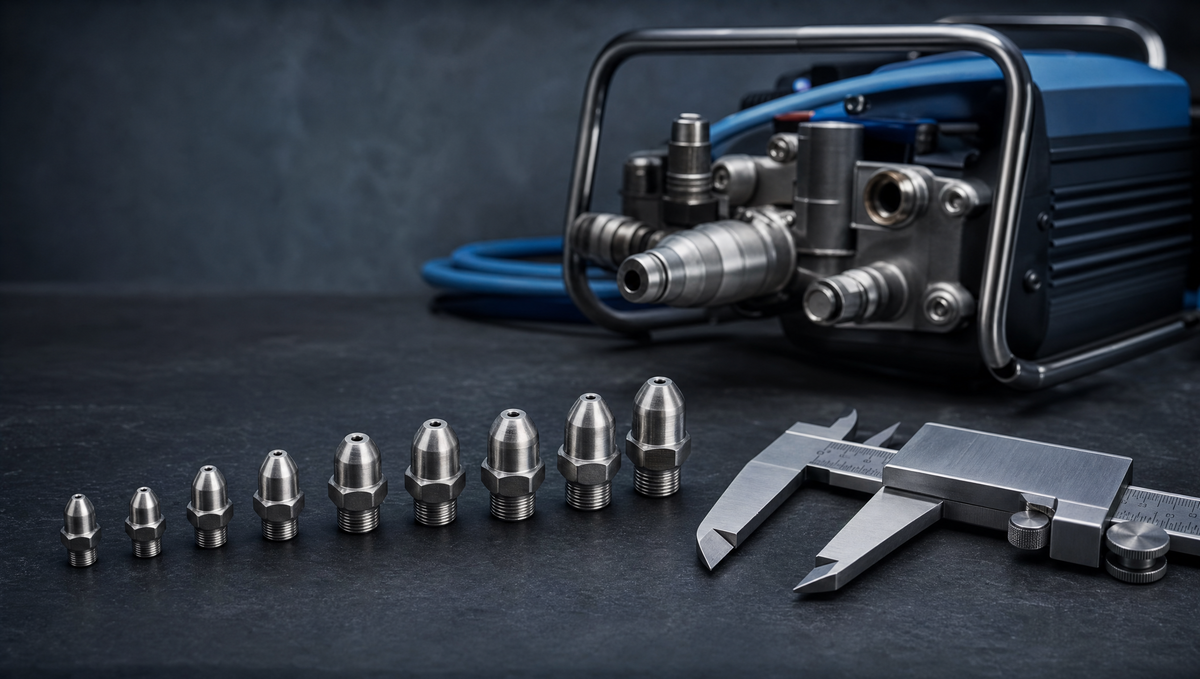
Your nozzle inserts determine how your jetter performs. Wrong-sized inserts mean wasted water, reduced pressure, poor cleaning performance, or even equipment damage. Here is how to match inserts to your specific machine for optimal results.
Understanding Insert Sizing Basics
Jetter nozzle inserts are the replaceable components that create the individual water jets. Each insert has a specific orifice diameter that controls how much water flows through it and at what pressure. The total flow through all inserts on a nozzle must match your machine output.
Think of it this way: your pump produces a fixed amount of water at a specific pressure. The inserts divide that water into individual jets. If the total orifice area of all inserts is too large, pressure drops. If it is too small, you are not using your machine full capacity and the pump works against excess back-pressure.
Key Specifications You Need
Before sizing inserts, know these numbers for your machine:
- Maximum GPM: The total water volume your pump produces
- Maximum PSI: The working pressure of your system
- Number of inserts on your nozzle: Typically 4-8 depending on the nozzle type
The Sizing Formula
Each insert orifice size has a flow rate at a given pressure. Manufacturers provide flow charts for their inserts. The goal is to select insert sizes where the total combined flow equals your machine GPM at your working PSI.
Example: Your machine produces 8 GPM at 4,000 PSI. Your nozzle has 6 rear inserts and 1 forward insert (7 total). You need inserts whose combined flow at 4,000 PSI equals 8 GPM.
If each rear insert flows 1.0 GPM at 4,000 PSI and the forward insert flows 2.0 GPM, total flow is 8.0 GPM—a perfect match.
What Happens with Wrong-Sized Inserts
Inserts Too Large (Over-Flow)
- Pressure drops because the pump cannot maintain PSI at the demanded flow rate
- Weak, unfocused jets that clean poorly
- The pump works at maximum capacity without delivering results
- Increased pump wear and potential overheating
Inserts Too Small (Under-Flow)
- Excessive back-pressure on the pump
- Pressure relief valve activates, wasting water and energy
- Reduced cleaning coverage because less water reaches the pipe
- Potential pump damage from sustained over-pressure conditions
Matching Inserts to Common Machine Sizes
Small Machines: 2-4 GPM
These machines need smaller orifice inserts. A 4-insert nozzle with each insert flowing about 0.75-1.0 GPM at your working pressure is typical. Avoid nozzles designed for larger machines—the inserts will be too large and you will lose pressure.
Mid-Range Machines: 6-10 GPM
The most common setup for residential and light commercial work. Six-insert nozzles with medium orifices work well. You have flexibility to use different insert sizes for forward and rear jets—a slightly larger forward insert for penetration power and smaller rear inserts for wall cleaning.
Large Machines: 12-18 GPM
High-flow machines need larger inserts or more of them. Eight-insert nozzles with medium-large orifices handle these flow rates. At this volume, you can run very aggressive jet patterns for heavy-duty cleaning.
Using Insert Charts
Professional nozzle manufacturers provide flow charts that list orifice sizes, flow rates at various pressures, and recommended configurations for different machine outputs. Keep these charts in your truck. When swapping inserts, reference the chart to confirm your configuration matches your machine.
Mixing Insert Sizes
You do not have to use the same size insert in every position. In fact, mixing sizes gives you tactical advantages:
- Larger forward insert: Concentrates more water forward for penetrating power on blockages
- Smaller rear inserts: Spread water across more jets for wider pipe wall coverage
- No forward insert: Directs all flow to rear jets for maximum wall cleaning on grease lines
Just make sure the total combined flow still matches your machine GPM.
Ceramic vs Steel Inserts
Ceramic inserts maintain their orifice diameter much longer than steel. Steel inserts erode over time, gradually increasing the orifice size and changing your flow characteristics. If you notice your nozzle performance declining, worn inserts are often the cause.
Ceramic inserts resist wear and maintain consistent performance for significantly more operating hours. The upfront cost is higher, but the consistent performance and longer life make them more cost-effective for daily use.
Regular Insert Inspection
Check your inserts regularly:
- Look for wear, chipping, or erosion around the orifice
- Compare jet patterns to when inserts were new—uneven or weak jets indicate wear
- Replace inserts in matched sets when possible for consistent performance
- Keep spare inserts in your truck so a worn insert never costs you a job
Shop nozzles and inserts at jetterprosupply.com or call (866) 595-0515.
Put it into practice: Replacement Inserts — Once you've sized your machine, matching inserts are easy to dial in here. Questions? Call (864) 804-6637.
New to jetting? Start by learning how to build a complete nozzle kit on a budget.
Need the right nozzle for the job?
Talk to someone who runs this gear, or shop our full lineup of pro-grade jetting nozzles.