
Understanding GPM, PSI, and Flow: The Math Behind Nozzle Performance
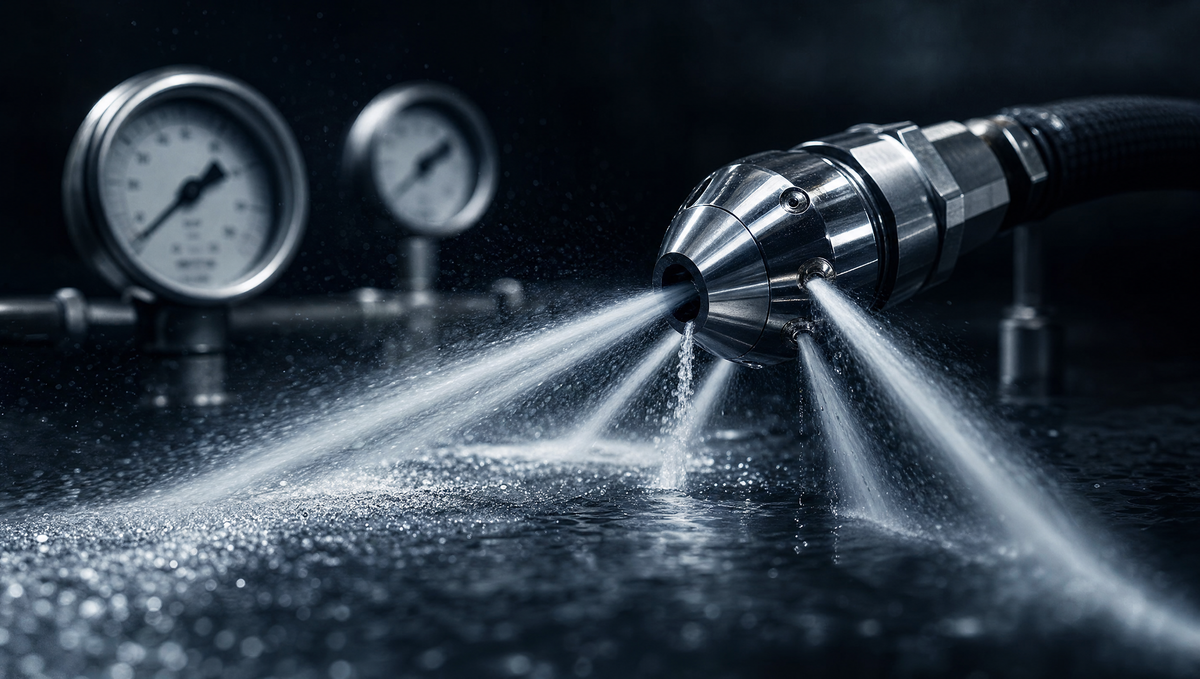
Every jetter has two key specs: GPM (gallons per minute) and PSI (pounds per square inch). Every nozzle is designed to work within specific GPM and PSI ranges. Understanding how these numbers interact is the difference between a nozzle that cleans effectively and one that wastes water and time.
You do not need an engineering degree. Here is the practical math that helps you choose the right nozzles and inserts for your setup.
GPM vs PSI: What Each One Does
PSI (Pressure)
PSI is the force behind the water. Higher PSI means the water hits harder. In jetting terms:
- PSI determines cutting power -- how aggressively the water can break through blockages and remove buildup
- More PSI = more ability to cut roots, blast through grease, and strip scale
- But PSI alone does not clean a pipe. A pinhole stream at 10,000 PSI is powerful but covers almost nothing.
GPM (Flow)
GPM is the volume of water. Higher GPM means more water moving through the pipe. In jetting terms:
- GPM determines flushing power -- how much debris and waste gets carried downstream
- More GPM = better wall-to-wall coverage and faster debris removal
- GPM is what actually fills the pipe and creates the hydraulic action that scrubs pipe walls
The Simple Analogy
Think of PSI as the speed of a punch and GPM as the weight behind it. A fast, light punch (high PSI, low GPM) can poke through things but does not move much. A slower, heavy hit (lower PSI, high GPM) moves everything in its path. The best jetting results come from balancing both.
How Nozzle Orifice Size Controls Performance
Here is where it all comes together. The orifice (the hole in each nozzle insert) is the throttle that controls how your jetter GPM and PSI are converted into cleaning power.
- Smaller orifice: Restricts flow, increases pressure at the nozzle tip. Produces a tighter, more forceful stream. Good for cutting through tough blockages.
- Larger orifice: Allows more flow, reduces pressure at the tip. Produces a wider, higher-volume stream. Good for flushing and wall cleaning.
The total orifice area across all jets in a nozzle must be matched to your jetter output. If the orifices are too small for your GPM, backpressure builds up and stresses your pump. If they are too large, pressure drops and you lose cutting power.
This Is Why Insert Sizing Matters
With replaceable insert nozzles from KEG Technologies, you choose the insert size that matches your jetter specs. A nozzle body designed for 4 GPM / 3,500 PSI uses different inserts than the same body running on an 8 GPM / 4,000 PSI machine. The inserts are the tuning mechanism.
This is a massive advantage over drilled (Tier 1) nozzles, where the orifice size is fixed at manufacturing. If your jetter output does not perfectly match the drilled holes, you are stuck with suboptimal performance. With replaceable inserts, you dial in exact performance for your specific equipment.
Practical GPM/PSI Guidelines for Residential Plumbers
Here is what different jetter setups are capable of and the jobs they handle:
2-3 GPM / 2,500-3,000 PSI (Small Cart Jetter)
- Bathroom drains and small kitchen lines (1.5"-3")
- Light grease cleaning
- Maintenance jetting on small lines
- Use small-orifice inserts to maximize pressure from limited flow
4-5 GPM / 3,500-4,000 PSI (Standard Cart/Trailer Jetter)
- The residential sweet spot
- Kitchen drains, bathroom drains, sewer laterals (2"-6")
- Grease, roots, and general cleaning
- Enough flow for effective rotor nozzle operation
- Most Jetter Pro Supply nozzles are optimized for this range
6-8 GPM / 3,500-4,000 PSI (Large Trailer Jetter)
- Full-size sewer mains (4"-8")
- Heavy root cutting
- Commercial and light municipal work
- Can power larger rotor nozzles effectively
10+ GPM / 4,000+ PSI (Truck-Mounted)
- Large commercial and municipal lines (8"-12"+)
- Typically beyond residential plumbing needs
- Maximum cleaning power for the toughest jobs
How to Match Inserts to Your Jetter
When selecting ceramic inserts from Jetter Pro Supply, follow these principles:
- Know your jetter output: Check your machine specs for maximum GPM and PSI at the pump.
- Account for pressure loss: You will lose 10-20% of pressure over a long hose run. A 4,000 PSI pump might deliver 3,200-3,600 PSI at the nozzle.
- Match total orifice area: The combined area of all jet orifices should allow your full GPM to flow at or near your working PSI. Nozzle spec sheets from KEG Technologies list the recommended GPM/PSI ranges.
- Start conservative: If you are between insert sizes, go with the smaller orifice. You get more pressure and can always move up. Going too large wastes pressure that is hard to recover.
Why Worn Inserts Kill Performance
Here is where insert material really matters. As an orifice wears, it gets larger. A larger orifice means:
- More GPM flowing through = less pressure per jet
- Wider, weaker spray pattern = less effective cleaning
- Your jetter pump works harder to maintain flow = more fuel, more wear
- Job times increase because each pass is less effective
Steel inserts wear relatively quickly, especially in sandy or gritty conditions. The orifice can enlarge 10-20% in just a few months of regular use. Ceramic inserts resist this wear dramatically -- maintaining their engineered orifice diameter for 10x longer than steel. That means consistent GPM/PSI delivery and consistent cleaning results throughout the insert life.
The Bottom Line
Jetting performance comes down to three things: your machine (GPM + PSI), your nozzle design (jet angles and count), and your insert sizing (orifice diameter). You cannot change your machine specs in the field. But you can change your inserts in 2 minutes to optimize for different jobs and conditions.
That flexibility is what makes the KEG Technologies replaceable insert system so valuable. One nozzle body, multiple insert options, always matched to your equipment for peak performance.
Shop nozzles and precision ceramic inserts at Jetter Pro Supply -- German-engineered, 5-year ceramic insert warranty, same-day shipping on inserts, free shipping over $199.
Put it into practice: Tier 3 Ceramic Nozzles — Nozzle geometry drives real-world flow; our Tier 3 line is built with that efficiency in mind. The tier standard is explained in the NASSCO Tier 3 Guide. Questions? Call (864) 804-6637.
Need the right nozzle for the job?
Talk to someone who runs this gear, or shop our full lineup of pro-grade jetting nozzles.