
Root Cutting with Rotor Nozzles: A Field Guide for Plumbers
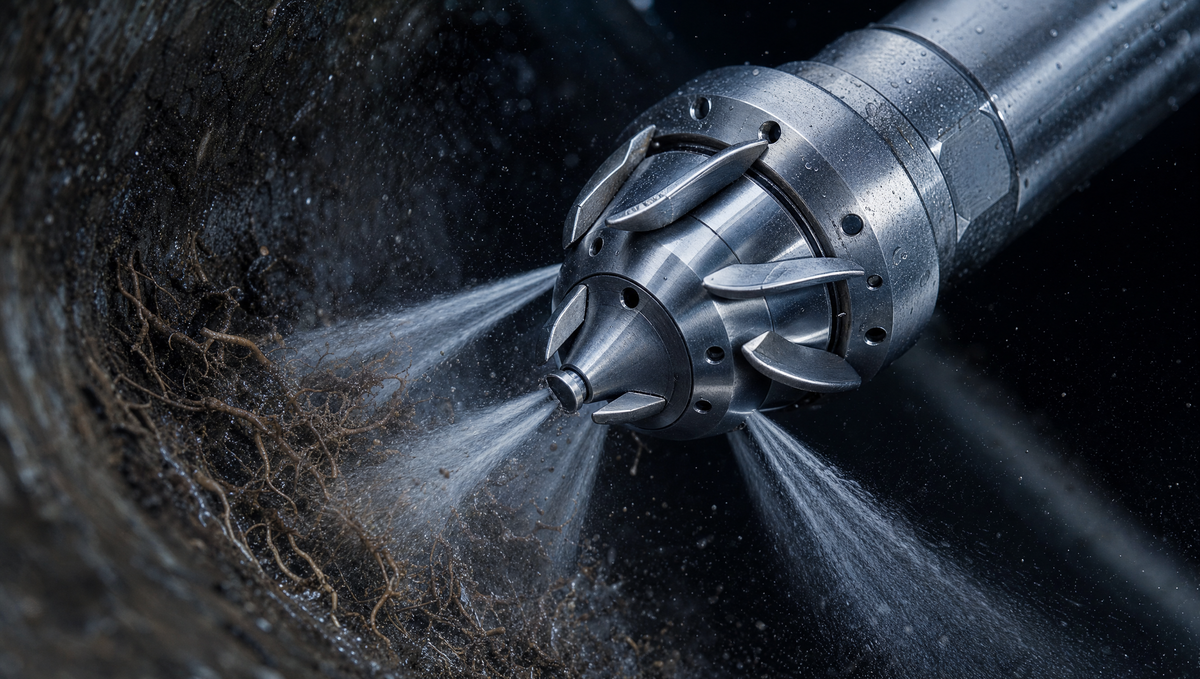
Roots in sewer lines are one of the most common -- and most lucrative -- problems residential plumbers deal with. A single root-cutting job bills $500-$900, and the roots always grow back, creating built-in recurring revenue. But to do the job right, you need the right tool: a rotor nozzle.
Roots love old clay and cast iron lines -- see our field guide on jetting clay and Orangeburg pipe.
For non-organic obstructions like hardened deposits, see removing concrete, mortar or grout.
This field guide covers how rotor nozzles work, when to use them, and the techniques that separate a clean job from a callback.
How Rotor Nozzles Work
Unlike standard flushing nozzles that use fixed rear-facing jets, rotor nozzles have a spinning head driven by water pressure. As water flows through the nozzle, it spins an internal turbine that rotates the cutting head at high speed. This rotating action directs a concentrated water jet in a circular pattern, effectively cutting through roots like a water-powered saw.
The spinning action gives rotor nozzles two key advantages:
- Concentrated cutting force: Instead of spreading water across multiple jets, the rotor focuses energy on one point that sweeps 360 degrees
- Self-feeding action: The rotating jet pattern pulls the nozzle forward through root masses, reducing the pushing force you need to apply
45-Degree vs 90-Degree Rotor Nozzles
Rotor nozzles come in two main configurations, and understanding the difference is critical for choosing the right one:
45-Degree Rotor
- Jets angled at 45 degrees from the nozzle axis
- Provides both forward cutting and wall cleaning in one pass
- Best for: moderate root intrusion, combined root cutting and debris flushing
- More versatile -- good starting point if you only buy one rotor
90-Degree Rotor
- Jets aimed straight out at the pipe walls (perpendicular)
- Provides maximum cutting force directly against roots at the pipe wall
- Best for: heavy root intrusion, established root balls, stubborn growth
- More aggressive -- the root destroyer for serious jobs
Many experienced plumbers carry both. Start with the 90-degree to cut through heavy root masses, then follow up with the 45-degree for cleanup.
Step-by-Step Root Cutting Technique
- Camera first: Always run a camera inspection before cutting. You need to know where the roots are, how dense they are, and whether the pipe has structural damage that could be worsened by jetting.
- Start with the rotor: Feed your rotor nozzle to the root intrusion point. Let the nozzle do the work -- do not force it. The spinning action will pull it into the root mass.
- Work in short passes: Pull back 1-2 feet, then advance again. Each pass cuts deeper into the root mass. Rushing leads to tangled hose.
- Switch to a flusher: Once the rotor has cut through the major root mass, switch to a flushing nozzle to wash out the debris and clean the pipe walls.
- Camera verify: Run the camera again. Show the customer the clean pipe, and recommend a maintenance schedule (every 6-12 months) to keep roots from re-establishing.
Pairing Your Rotor With a Cleaning Nozzle
A rotor nozzle cuts roots, but it does not clean the pipe. You always want to follow root cutting with a thorough flush using a rear-jet cleaning nozzle. This two-nozzle approach gives customers the best result and dramatically reduces callbacks.
A solid root-cutting kit includes:
- One rotor nozzle (start with 45-degree for versatility or 90-degree for heavy roots)
- One flusher/penetrator nozzle for cleanup
- Both equipped with Tier 3 ceramic inserts for long life and consistent performance
Tips From the Field
- Watch your GPM: Rotor nozzles need adequate flow to spin properly. Check the nozzle specs against your jetter output. An undersized jetter will not spin the rotor effectively.
- Do not ignore pipe condition: If the camera shows cracked or collapsed pipe, jetting can make it worse. Know when to recommend repair or lining instead.
- Roots mean repeat business: Roots grow back. Every root job is a future maintenance customer. Set them up on a 6-12 month schedule and you have built-in recurring revenue.
- Ceramic inserts matter here: Root cutting is abrasive work. Steel inserts wear fast under these conditions. Ceramic inserts from KEG Technologies last 10x longer and maintain the precise orifice size your rotor needs to spin correctly.
Get Equipped for Root Cutting
Root jobs are some of the highest-paying residential calls you will take. With the right rotor nozzle and technique, each job takes 45-90 minutes and bills $500-$900. Pair that with recurring maintenance and you have a revenue stream that grows every year.
Shop rotor nozzles and root-cutting equipment at Jetter Pro Supply -- German-engineered, assembled in Spartanburg SC, with same-day shipping on inserts.
Put it into practice: Root & Blockage Nozzles — Rotor and root-cutting work is exactly what these nozzles are built for. Questions? Call (864) 804-6637.
Need the right nozzle for the job?
Talk to someone who runs this gear, or shop our full lineup of pro-grade jetting nozzles.